Bessler Start Page
Wheel Drawings
A Closer Look
Home Page
The Bi-Directional Wheel:
Shown below is the first of three of Bessler's important drawings of his wheels found in the book "The Triumphant Perpetual Motion Machine of Orffyreus". (Shortened English version of title). Every line of this book was written in both German and Latin.
There is a twin sister drawing in Bessler's 1715 book "A Very Thorough Report". These drawings are identical except for a few important details that are mostly discussed on another web page.
If you only casually look at Bessler's drawings you will not see very much. But when you begin to study the details and find a clue or code you discover a trail of clues that is either meant to take the seeker to paradise or dirve him insane. One must avoid reading too much into the documents, without overlooking the smallest possibilities.
Observations and Oddities
As you look over the drawing most of the numbers are easy to find. The number 5 is another matter, in the lower left area on both this and the twin drawing. Why is number 5 so difficult to find, what's the meaning?
The two weighted T-bars in the left half of the drawing are both positioned as if the hook is being pulled down. The assembly to the right however indicates the hooked arm is being pushed upward. Why?
The pendulum weights, I believe, are actually a depiction of the driving force mechanism of the wheel. Part of the far left pendulum T-bar is identically cut off on both twin drawings. This fact indicates that it was intentionally cut off at the edge of the drawing and again what does it mean?
Everyone of Besslers drawings has something going in/out of a window which is an unusual characteristic in and of itself. This drawing and the twin drawing have an opening or hole at the bottom of the support column as well. It looks as if the floor pulley could have been positioned a few inches either way to avoid the additional work of carving a rectangular hole. Is it a literal necessity for a squre cornered hole here or is it figurative?
I don't believe that anyone can give a perfect translation of the text keys because the original intent of the author was to confuse and entice his audience. It is also subject to the influence and opinions of the translator. Some of the text, and the drawings could be taken literal and some as figurative.
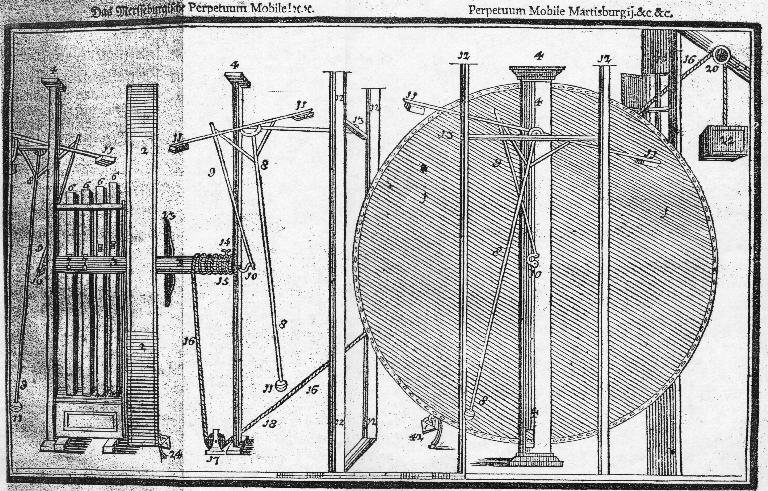
TEXT KEY
1. Is the size or
circumference of the main machine.
2. The thickness or profile through main machine.
3. The main, or special shaft through the middle of
machine.
4. Wooden boards between which the machine is suspended
and works.
5. Frame position for the "hammer mill" and/or
stamping.
6. Four heavy stamps which are alternately lifted in
pairs.
7. Eight curved arms are firmly mounted in secial
places on the main shaft to elevate the stamps.
8. Poles that are perpendicular to each other, and
span the circumference. They move uniformly and reset.
9. Small pole that the perpendicula are moved by.
10. Iron hooks firmly affixed at the axle that move
the shaft.
11. Weights on the end(s) of the perpendicul.
12. Wooden border of a door from which one perpendicul is
suspended.
13. A small pole, slanting to the perpendicul, that must
hold it up.
14. Iron screw in the shaft, on which the rope is
coupled.
15 Here the rope winds around the main shaft.
16. Shows the total length(s) of the rope.
17. Small wheels on the floor, through which the
rope runs.
18. The rope goes through a hole in the board.
19. The rope goes through the window.
20. Small wheel by the window over which the rope runs.
21. Piece of wood on which the small wheel moves.
22. Box full of rocks by itself as the machine from the
deep raised.
23. An arm which sends & holds machine.
24. Lock and chain to hold the machine firmly.
The One-Directional Wheel:
Bessler gave these two drawings the unusual titles "First Figure" and "Second Figure" because they are the last two drawings in Bessler's 1719 book "The Triumphant Perpetual Wheel".
The 1st Fig. drawing is lettered 'a' through 'i', 'k' through 't' and includes the number 10. The only letter missing in the natural series is 'j'. The reason appears to be that the letters 'i' and 'j' were the same in the old German language. The same is true of the letters 'u' and 'v'. The 2nd Fig. drawing is labeled 1 to 10 with the 10's indicating the same object in both drawings. These facts tell me that Bessler was expecting the reader to view them as a unit like the two sides of a coin.
I have spent, maybe too much, time looking at the lettering/numbering system of the drawings
If you start counting through the letters of the 1st Fig., 'i' being the number 1, skip 'j', 'k' is 2, and so on. You will find that the sixth letter is 'o', the bucket full of water and similarly the number 6 in the 2nd Fig. is the box full of rocks. Both are weights hanging from the end of a rope.
The seventh letter 'p' is the last item in the left panel of 1st Fig and the number 7 is the last item in the left panel of 2nd Fig. There are four 8's in the right panel of the "second" drawing and the first four letters of the right panel on the "first" drawing could represent the same mechanism in a different light. These examples show that these two drawings could almost be interlaced like the pieces of a jig saw puzzle. I also think it is possible that there may be a hidden message or clues in the wording.
If you look at 2nd Fig. and read the text key of 1st Fig. (starting with the letter i) you will see that many of these descriptions fit in a metaphoric sense.
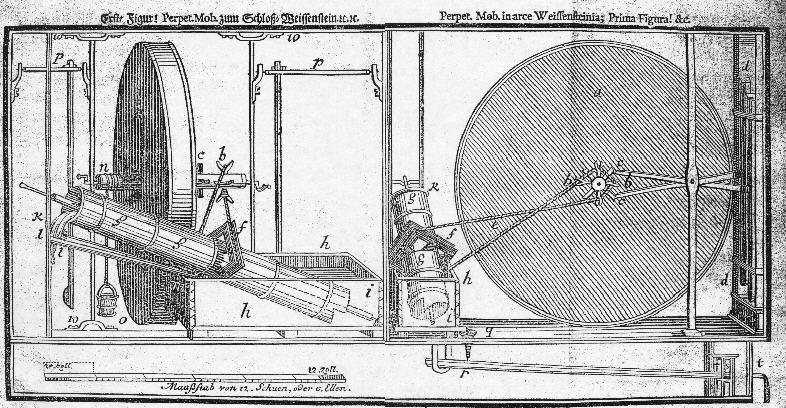
The First Figure:
The Perpetual Wheel that is similar in strange shape to the secret construction that existed at Weissenstein.
A. Shows the size of
the machine, circumference and profile.
B. Four forks screwed into the main shaft for pulling the
snail (water pump)
C. Hooked wooden arms in the main shaft, to elevate the
stamps.
D. The stamps themselves which are lifted through the
lath.
E. The rope that moves the water-pump.
F. A square wheel on the pump, over which the rope runs.
G. The water-pump itself is run by the perpetual mobile.
H. The water box which the spiral pump empties.
I. Here is one of the openings of the pump which scoops
the water.
NO 'J'
K. Here different is the very same hole where she
empties.
L. The water pours water forcefullyr out of the
pump and into the wooden pole
M. Water goes repeatedly out of and into the box.
N. Shows how something is transported on the main shaft
itself.
O. Shows a water basket which is elevated through the
machine.
P. The perpendicul, when the machine is supposed to move
slowly.
Q. The out running water runs in funnel through the floor
hollow-throat.
R. Out of the funnel the water then decends in a channel.
S. The spout goes out of the windows.
T. The water which was brought by the basket then flows
away.
10. Shows a transparent layout of the machine.
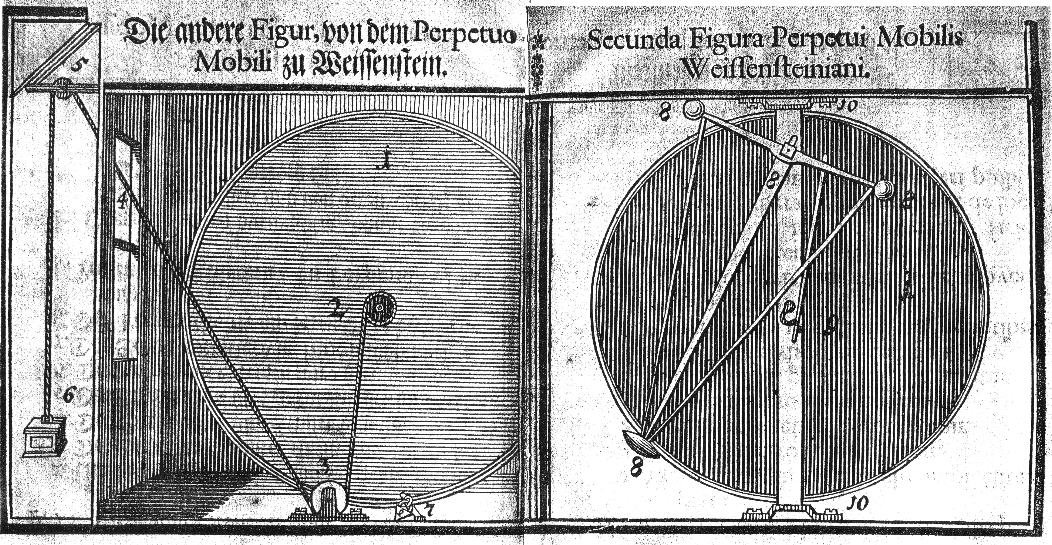
The Second Figure, of the perpetual mobile at Weissenstein.
1. The whole
size of the wheel or perpetual mobile.
2. The rope winds around the main shaft.
3. The rope runs under a small wheel.
4. The rope goes through the window.
5. The rope is suspended by a small wheel.
6. The box with stones is pulled up.
7. The lock, when the machine is not working.
8. The perpendicul, at it's end three weights.
9. Iron hooks affixed to small poles that move the
perpendicul strongly.
10. Above and underneath transparent, so the machine can
stand free and be moved when needed.
Copyright ©: This document may be
freely reproduced for noncommercial purposes but only if
all
parts and text are complete and unaltered, including this
copyright information. All other rights reserved.
No part text or image of this publication may otherwise
be reproduced, or transmitted, in any form or
by any means, electronic, mechanical,photocopying,
recording or otherwise, without the prior permission of
the
copyright owner.